Stockwatch: could this triple shock disrupt the equities party?
Stock markets remain near record highs, but serious threats to oil prices mean the risk of recession is never far away. Analyst Edmond Jackson shares his view on the current situation.
4th August 2026 10:53
by Edmond Jackson from interactive investor

With the FTSE 100 around all-time highs, it may be wise to consider the rising risk scenario for energy prices and inflation.
Within this momentum I’ve examined situations where crowded short trades meant equities have bounced back anywhere from 20% to 100% (latterly recruitment group Hays (LSE:HAS)) on trading updates that defied doom. While such occurrences could mark inflection points, we shouldn’t lose sight of a key macro risk of why short positions were established in turnaround and cyclical shares.
- Invest with ii: Top UK Shares | Share Tips & Ideas | Cashback Offers
Recently, it has been easy to assume a 60-day ceasefire between Iran and the US would result in some kind of settlement, with both sides possibly tiring of conflict. Oil prices around $80 a barrel have also defied expert predictions last spring that there would be a spike to $150 come June and that this would act as a tipping point for much else. Instead, and helped by a global release of over 400 million barrels of oil in emergency reserves, Brent crude fell from $118 on 29 April to as little as $72 on 1 July, setting the stage for a rebound in equities.
In terms of consumer confidence, fuel pump prices appeared to consolidate or even fall, and it seemed worth taking the risk of variable energy tariffs if one’s fixed-price tariff was expiring. UK inflation fell to 2.6% in June from 2.8% in May, its lowest rate since March 2025.
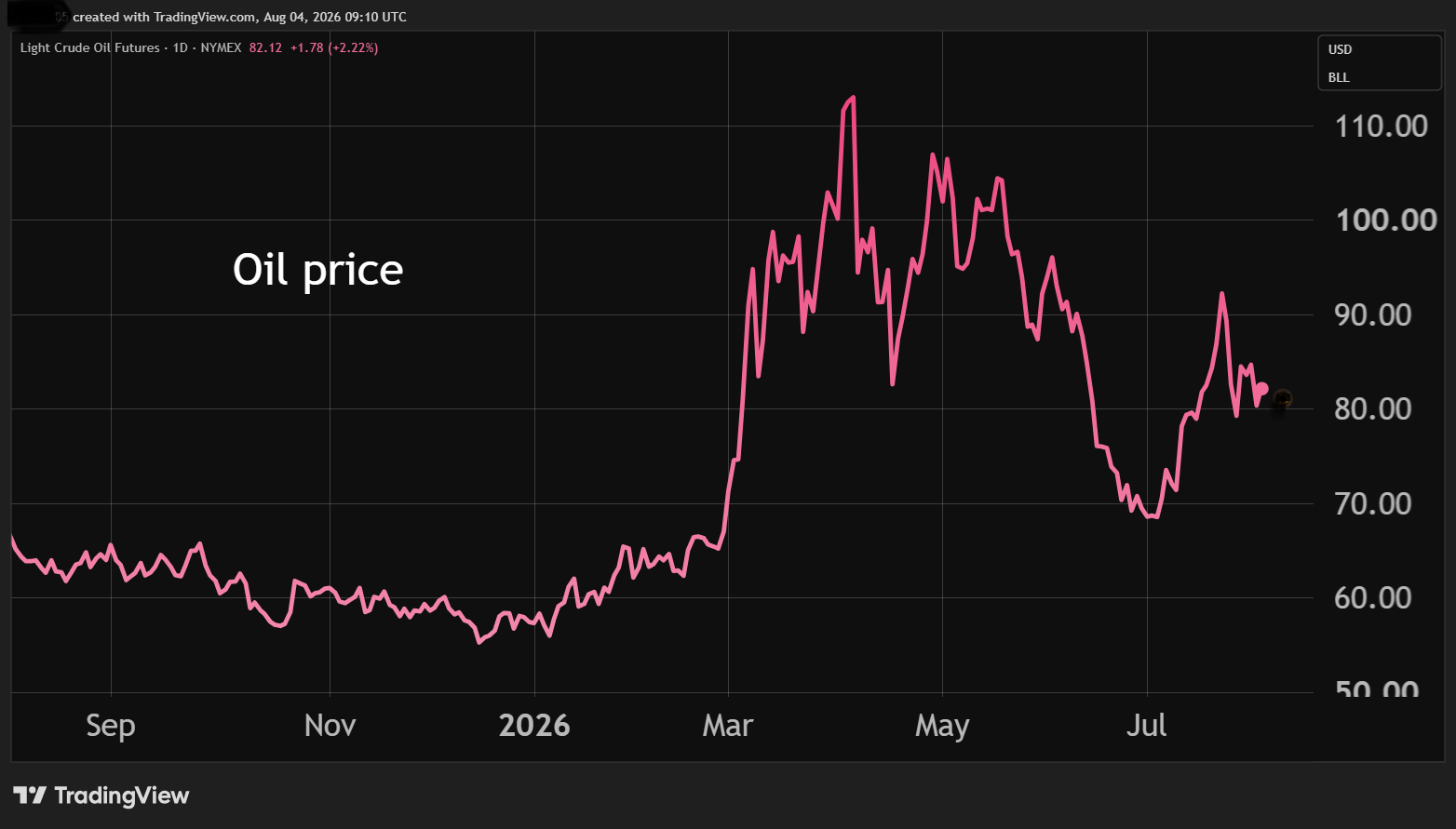
Source: TradingView. Past performance is not a guide to future performance.
Conflict over oil passage spreads
Yet a durable peace settlement seems elusive, with resumed hostilities between the US and Iran making one trickier to nail down. Iran is better placed for a war of attrition as the US mid-term elections approach, and the US has also run down its high-end ammunition stock. With control of the Strait of Hormuz, Iran can choke much of the developed world for energy and other vital commodities - around four million barrels of oil per day are missing from the global market, around a 15% cut to global supply.
Last March, Saudi Arabia responded to the closure of Hormuz by re-routing oil to the country’s east coast where a Red Sea port now handles over 70% of Riyadh’s crude oil exports. That proved a lifeline for Asian nations such as China, which is the largest buyer of Saudi oil.
But on 20 July, the Houthis announced a naval blockade against Saudi Arabia and also took responsibility for an attack on a Saudi tanker, hence on 30 July Riyadh announced a new multinational maritime defence coalition. The Houthi leader retaliated by way of threatening “full escalation”.
Russian and Chinese oil supplies reduce
Ukraine has had growing success attacking Russian oil refineries using long-range drones as part of a strategic campaign to disrupt military fuel supplies and weaken Russia’s war economy. On 1 August it hit three refineries in the Russian republic of Bashkortostan, which processes millions of tonnes a year. It also sank a sanctioned Russian container ship in the Black Sea.
Complex engineering means such refinery damage cannot be resolved promptly, and this aspect of disruption is estimated to have withdrawn at least a further three million barrels a day to global supply.
- Trading Strategies: a FTSE 100 retailer offering value for money
- FTSE 100 ex-dividend dates: August 2026
- Shares for the future: hedging my bets on this AIM stock
There’s a third element behind a possible imminent shock to fuel prices. China reduced its active oil processing to the extent of 40% by mid-2026, albeit combined with reduced imports (hence less pressure on global inventories). This is chiefly to balance out high pre-existing domestic inventories, although Beijing has also enforced strict curbs and bans on refined fuel exports to safeguard energy security.
All this when oil emergency buffers are depleted
There was a record 129 million-barrel drop in global inventories during March and 117 million barrels in April, amid a cumulative supply deficit exceeding one billion barrels as key Gulf producers have run around 14 million barrels a day below pre-crisis levels.
The International Energy Agency (IEA) has warned that the global safety net has been heavily drained but obviously with Brent oil in a low $80 area, the market remains relatively optimistic. However, it did fall 10% initially yesterday on US President Donald Trump calling off a major strike on Iran, but it closed up 0.8% at $83.5 a barrel.
Infrastructure constraints and blocked shipping lanes are also compromising liquefied natural gas (LNG) supply. For example, attacks on two major gas export plants in Qatar have severely limited production with full recovery not expected until late 2027.
European natural gas storage was around 54% as of late July, far below the typical 90% needed ahead of winter. It is already leading to Europe/Asia competition for replacement LNG, pushing up prices. Gas prices have risen generally. For example, EU natural gas is up from around €40 per Megawatt hour (MWh) at end-June to €64 MWh as of 24 July. It’s currently around €58 MWh.
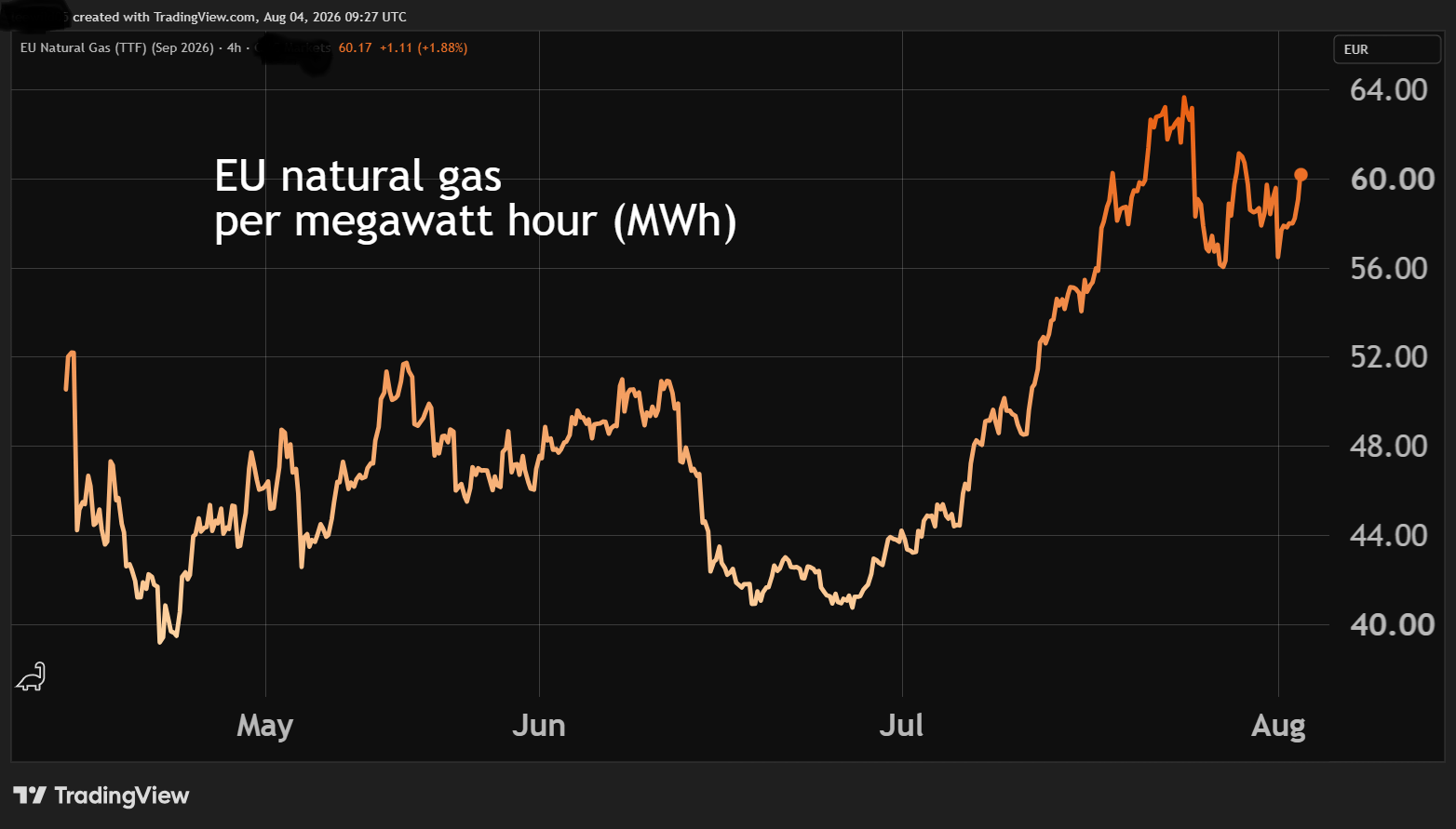
Source: TradingView. Past performance is not a guide to future performance.
Upward risk to fuel prices
The price at which oil could trigger a recession is perceived to be in the area of $130-$150 a barrel, so it would take a major change in current circumstances. However, could a conflation of elements described above result in one come September? We should at least be aware of the worst-case scenario potential.
Mind the “crack spread” - the price difference between crude oil and products refined from it, a key gross margin measure for an oil refinery. It has surged to record highs such as $90 a barrel for European diesel crack and $93 in the US where a benchmark “3-2-1” spread has surged past $60, higher than during the 2022 energy crisis. It’s as if energy price rises are latent, with finished fuel prices under high upwards pressure relative to the cost of crude oil.
Consultancy group EY warned at the start of this week that the UK could fall into recession next year if the Strait of Hormuz remains closed. Its latest economic outlook predicts gross domestic product (GDP) could slow sharply to 0.5% this year and contract by 0.2% next year. Such forecasts are inevitably sketchy, but EY is essentially saying uncertainty remains despite the UK proving more resilient than expected this year.
- Can MPC voting history predict next interest rate move?
- Sign up to our free newsletter for investment ideas, latest news and award-winning analysis
The FTSE 100 was quite flat yesterday in response to plunging Brent crude, as if investors are now accustomed to major changes in a story which can be easily reversed. Iran denied any latest peace talks and is not exactly looking desperate. Meanwhile, Trump has entertained serial breakthroughs that never happened.
The domestic FTSE 250 index actually rose 1% yesterday, as if UK-oriented shares may already price in such risks on a long-term view, as shown by serial takeovers of mid- to small-caps. Good reasons therefore exist for investors, classically exposed to this area of the market for better total return prospects, not to flinch in the face of renewed energy risk.
It does, however, pose questions about timing fresh investments, as if recent complacency over the US/Iran war might soon get a rude awakening.
My decision a few months ago not to engage a new fixed-price energy contract given that oil prices were falling, is also looking exposed!
Edmond Jackson is a freelance contributor and not a direct employee of interactive investor.
These articles are provided for information purposes only. Occasionally, an opinion about whether to buy or sell a specific investment may be provided by third parties. The content is not intended to be a personal recommendation to buy or sell any financial instrument or product, or to adopt any investment strategy as it is not provided based on an assessment of your investing knowledge and experience, your financial situation or your investment objectives. The value of your investments, and the income derived from them, may go down as well as up. You may not get back all the money that you invest. The investments referred to in this article may not be suitable for all investors, and if in doubt, an investor should seek advice from a qualified investment adviser.
Full performance can be found on the company or index summary page on the interactive investor website. Simply click on the company's or index name highlighted in the article.
Disclosure
We use a combination of fundamental and technical analysis in forming our view as to the valuation and prospects of an investment. Where relevant we have set out those particular matters we think are important in the above article, but further detail can be found here.
Please note that our article on this investment should not be considered to be a regular publication.
Details of all recommendations issued by ii during the previous 12-month period can be found here.
ii adheres to a strict code of conduct. Contributors may hold shares or have other interests in companies included in these portfolios, which could create a conflict of interests. Contributors intending to write about any financial instruments in which they have an interest are required to disclose such interest to ii and in the article itself. ii will at all times consider whether such interest impairs the objectivity of the recommendation.
In addition, individuals involved in the production of investment articles are subject to a personal account dealing restriction, which prevents them from placing a transaction in the specified instrument(s) for a period before and for five working days after such publication. This is to avoid personal interests conflicting with the interests of the recipients of those investment articles.