Stockwatch: is this share an emerging global oil & gas major?
Now one of the most internationally diversified oil & gas producers on the planet, analyst Edmond Jackson discusses whether investors should back it to keep growing.
6th March 2026 10:25
by Edmond Jackson from interactive investor

Harbour Energy (LSE:HBR) has delivered stonking 2025 numbers – that is if you “normalise” for a $3.0 billion (£2.2 billion) annual tax bill, having paid an effective rate of 106% on its North Sea operations.
From 1 November 2024, the new Labour government raised the energy profits levy on oil & gas companies to 38%, extending this to a total headline tax of 78% that will continue to 2030.
- Our Services: SIPP Account | Stocks & Shares ISA | See all Investment Accounts
But despite the income statement showing $2.8 billion pre-tax profit whittled down to a $182 million loss (after a loss also in 2024 when tax was 1.1x profit), Harbour shares were one of the biggest energy risers yesterday, up 9.5% to 285p, even ahead of Tullow Oil (LSE:TLW).
It likely shows respect for the most vigorous acquisitions policy I have seen from a mid-size producer in four decades of following the oil & gas sector. It has taken Harbour to a £4.5 billion valuation. Its 40% share price rise this year tracks a similar rally in oil prices, where normally oil shares lag the commodity given that it is more volatile, and due to company hedging policies. Yet investors are justifiably sensing Harbour is gearing to the higher price environment.
Impressive numbers from a major 2024 deal, with more to come
For analysts, it is a nightmare to accurately assess if true value is being created when a company is pursuing rapid and significant debt-funded acquisitions, and whether risk is rising due both to debt service costs and integration risks. It is one thing to flag exciting numbers in the aftermath of big takeovers; it is quite another to make it happen over a five-year time frame. Mind you, a favourable commodities pricing environment does help tilt the odds in Harbour’s favour.
- Where investment professionals are investing their ISA
- Stockwatch: should investors back these four oil stocks?
Showcasing record production up 84% to 474,000 barrels of oil equivalent per day (boepd), Harbour does not discern like-for-like performance nor regarding a 64% increase in 2025 revenue to $10.1 billion. This substantially derives from the $11.2 billion acquisition of Wintershall Dea in September 2024, a major strategic pivot way from historic reliance on the North Sea. It is also supported by new wells coming on stream in the UK, Norway, Argentina and Egypt.
Last December’s $3.2 billion acquisition of LLOG, marking a strategic entry into the US Gulf of Mexico, is not included in these results but helps explain how 2026 is “off to a strong start”, plus an annual free cash flow target of $1.0 billion in 2028.
Harbour Energy - financial summary
year end 31 Dec
reporting in US$
| 2019 | 2020 | 2021 | 2022 | 2023 | 2024 | 2025 | |
| Turnover ($ million) | 1,585 | 2,414 | 3,479 | 5,390 | 3,715 | 6,158 | 10,091 |
| Operating margin (%) | 28.7 | -28.5 | 18.4 | 47.1 | 25.1 | 26.8 | 34.6 |
| Operating profit ($m) | 455 | -687 | 640 | 2,541 | 932 | 1,648 | 3,490 |
| Net profit ($m) | 164 | -778 | 101 | 8.2 | 45.0 | -93.0 | -182.0 |
| Reported earnings per share (cents) | 343 | -2,208 | 11.6 | 162 | 5.6 | -10.0 | -15.0 |
| Normalised earnings per share (cents) | 397 | 34.4 | 39.3 | 150 | 24.5 | 33.0 | 31.0 |
| Operating cash flow per share (cents) | 2,455 | 3,896 | 185 | 343 | 266 | 148 | 214 |
| Capital expenditure per share (cents) | 535 | 1,697 | 73.8 | 70.1 | 99.1 | 122 | 115 |
| Free cash flow per share (cents) | 1,921 | 2,199 | 111 | 273 | 167 | 26.0 | 99.0 |
| Cash ($m) | 198 | 668 | 741 | 581 | 456 | 950 | 1,331 |
| Net debt ($m) | 2,704 | 1,655 | 2,800 | 1,482 | 821 | 5,071 | 4,454 |
| Net asset value ($m) | 1,132 | 1,067 | 474 | 1,021 | 1,553 | 6,251 | 6,206 |
| Net assets per share (cents) | 2,721 | 2,306 | 51 | 121 | 202 | 370 | 393 |
Source: company accounts.
Perhaps it reflects the market’s fascination with oil & gas right now: none of yesterday’s coverage of the results questioned the effect of this tax measure – which is set to last until March 2030 unless Labour is despatched sooner than an August 2029 general election – on Harbour’s intrinsic value.
The focus has been on Harbour’s burgeoning numbers and progress in creating one of the most internationally diversified oil & gas producers on the planet. Given it pursues a “scavenger” strategy of buying production assets, it appears not to have much exploration exposure. Some may see this as reducing risk rather than the volatility linked to inevitably mixed exploration news.
Debt raises sensitivity to oil & gas prices
Buying LLOG did, however, add $2.0 billion of debt to $5.2 billion existing (before $634 million leases), which last year generated a $689 million net interest charge when adjusting for $846 million cash. This was covered 5.1x by operating profit but it is good fortune how energy prices have now soared.
As with Tullow, debt significantly explains why the shares are sensitive to oil & gas price volatility. Harbour is set to benefit from gas prices up even more than oil currently, given its operations are well-balanced between the two.
Management’s confidence in this financial balancing act is implicit in guiding for free cash flow of $0.6 billion albeit based on $65 a barrel Brent oil and $11 European gas prices, where a $5 change in Brent or $1 change in gas boosts free cash flow by $170 million or $150 million respectively.
So, if Brent holds anywhere near $84.3 currently (and climbing), gas around $17 (with President Vladimir Putin capitalising on the crisis, threatening to cut off Russia-Europe gas supplies), then Harbour’s finances could be transformed.
What fortunate timing for its board now to link shareholder returns directly to free cash flow “with a base dividend and deleveraging alongside attractive organic growth opportunities in the near term”. Total distributions for 2025 have been $478 million, a 45% payout of free cash flow.
- Popular income stock makes big dividend cut
- Sign up to our free newsletter for investment ideas, latest news and award-winning analysis
In terms of yield, however, a total 27.8 cents dividend in respect of 2025 – equivalent to 20.8p and a yield of 7.3% with the shares at 285p – is expected to ease this year to around 19.7 cents or 14.8p, hence a prospective yield of 5.2%. That could well be higher if Middle East war proves protracted, keeping energy prices above Harbour’s budgeting. The results’ financial review explains an aspect of hedging – it’s why most often oil & gas shares do not mirror commodity price swings – although Harbour’s $7.2 billion net debt is significantly why its shares are leveraged to commodity price movements.
Distinguished CEO is catalyst for strategy and execution
Overall, I respect how chief executive Linda Cook is positioning Harbour Energy as a vibrant mid-cap. She has over 40 years’ of industry experience, including 29 at Shell where she became CEO of its gas & power side. She then chaired Chrysaor Holdings from mid-2014, which merged with Premier Oil in March 2021, gaining a London listing by way of reverse takeover. At the time, the group became the largest oil & gas producer in the North Sea, hence it was a target for the “windfall tax” and is why a radical strategic shift has been under way since 2024.
Yet the chart looks to be no roaring affirmation of her stewardship, the shares down from over 630p to 153p as of last April, although they may possibly be at the early stage of forming a “bowl” given Harbour’s underlying momentum and higher energy prices.
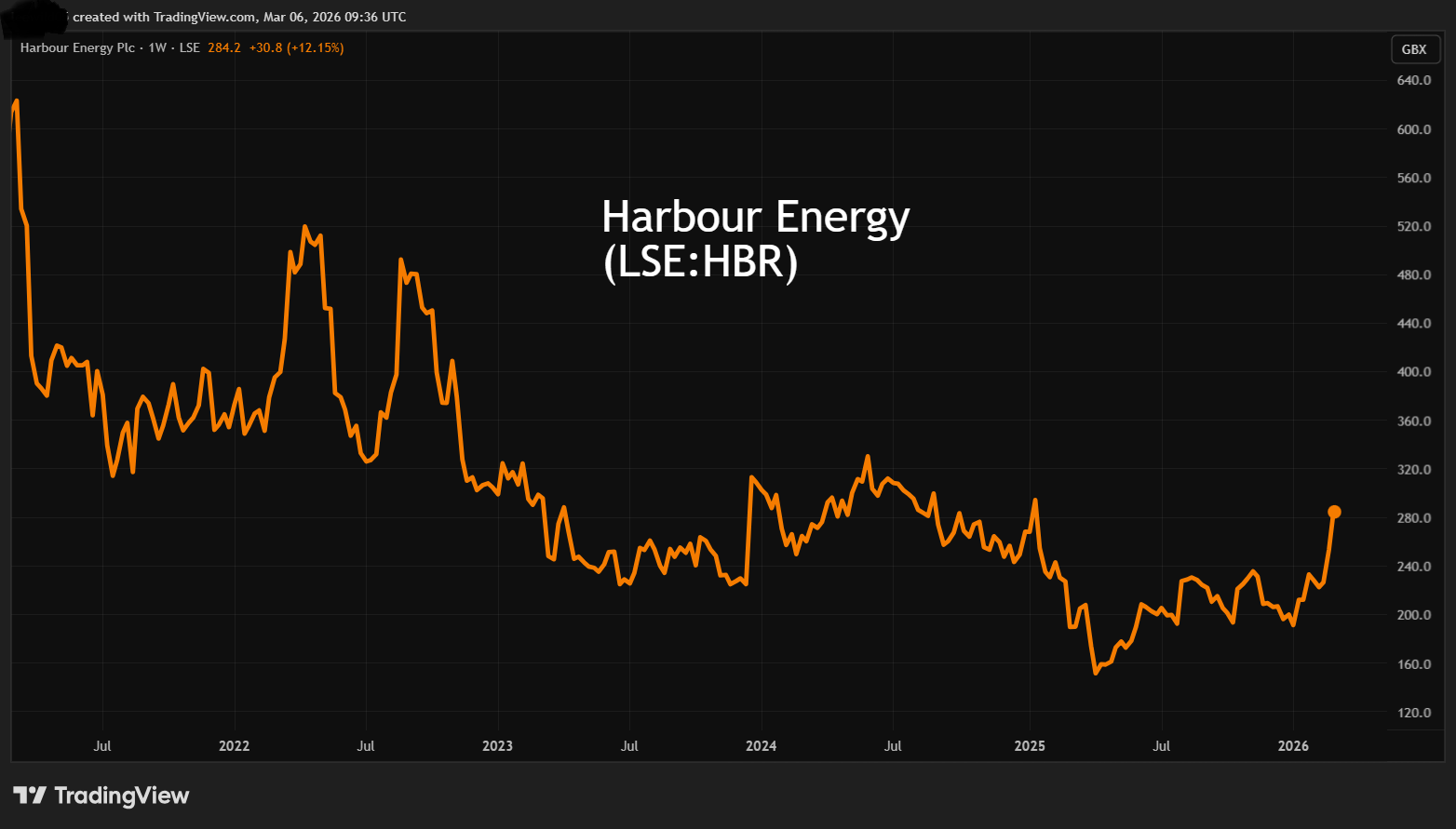
Source: TradingView. Past performance is not a guide to future performance.
In fairness, oil prices trended lower after the initial shock from Russia’s February 2022 invasion of Ukraine, and Harbour’s vigour caught my attention last August when I asked if mid-2025 was broadly an inflection point.
I liked its scavenger business model and I saw this work well in the 1990s when smaller companies such as Clyde Petroleum and Dana Petroleum bought and honed assets from oil majors. Early 2024 had seen a pivot to gas, and geographic spread was evolving. I concluded with a “buy” stance at 228p, regarding Harbour as having greater strategic clarity than BP (LSE:BP.) yet presenting lower financial risk than Tullow.
I concede I overlooked the windfall tax element; I was more concerned by $7.4 billion of decommissioning liabilities, classed as a provision under long-term liabilities. These have barely reduced over the year and constitute 119% of net assets. I thought they helped explain why the market was pricing for a relatively stronger yield (compensating for this risk) than you would expect from a mid-cap oil & gas share.
As with onerous North Sea taxes, management does not see fit to explain this in more detail in the results, but it is relevant to intrinsic value and risk versus reward. Hedge fund GLG Partners has flirted with a short position: 0.54% of issued share capital as of last 2 January, up to 0.90% on 17 February, but (as if cutting losses) reduced to 0.58% on 3 March.
A tantalising equity proposition
Respect to Harbour’s strategy and execution, yet there’s a sharp intake of breath at the extent of tax plus sleeping decommissioning liabilities. I cannot therefore regard it as investment quality – it being too hard to quantify intrinsic value in this mercurial machine – but I sense the market is right to pick up on Harbour as energy prices re-rate.
If this Middle East war drags on, and with Iranian proxies stubbornly disrupting oil tanker passage, then 2026 is going to turn out a lot different from the firm consensus only a week or so ago when oil was expected to trade in a $50-60 range.
On the other hand – and the big medium-term risk with chasing oil & gas shares right now – if Iran’s clerical regime is swept aside and the country doesn’t descend into civil war, and if the Revolutionary Guard is decimated and US President Donald Trump appoints his favoured leader who kowtows to US policy, you could see oil slump even lower than $50 when sanctions on Iranian exports are lifted.
Just typing that reinforces an overall feeling of incredulity. At 285p, I’ll stay with a speculative long-term “buy” stance on Harbour.
Edmond Jackson is a freelance contributor and not a direct employee of interactive investor.
These articles are provided for information purposes only. Occasionally, an opinion about whether to buy or sell a specific investment may be provided by third parties. The content is not intended to be a personal recommendation to buy or sell any financial instrument or product, or to adopt any investment strategy as it is not provided based on an assessment of your investing knowledge and experience, your financial situation or your investment objectives. The value of your investments, and the income derived from them, may go down as well as up. You may not get back all the money that you invest. The investments referred to in this article may not be suitable for all investors, and if in doubt, an investor should seek advice from a qualified investment adviser.
Full performance can be found on the company or index summary page on the interactive investor website. Simply click on the company's or index name highlighted in the article.
Disclosure
We use a combination of fundamental and technical analysis in forming our view as to the valuation and prospects of an investment. Where relevant we have set out those particular matters we think are important in the above article, but further detail can be found here.
Please note that our article on this investment should not be considered to be a regular publication.
Details of all recommendations issued by ii during the previous 12-month period can be found here.
ii adheres to a strict code of conduct. Contributors may hold shares or have other interests in companies included in these portfolios, which could create a conflict of interests. Contributors intending to write about any financial instruments in which they have an interest are required to disclose such interest to ii and in the article itself. ii will at all times consider whether such interest impairs the objectivity of the recommendation.
In addition, individuals involved in the production of investment articles are subject to a personal account dealing restriction, which prevents them from placing a transaction in the specified instrument(s) for a period before and for five working days after such publication. This is to avoid personal interests conflicting with the interests of the recipients of those investment articles.